
Sculpture and Materiality
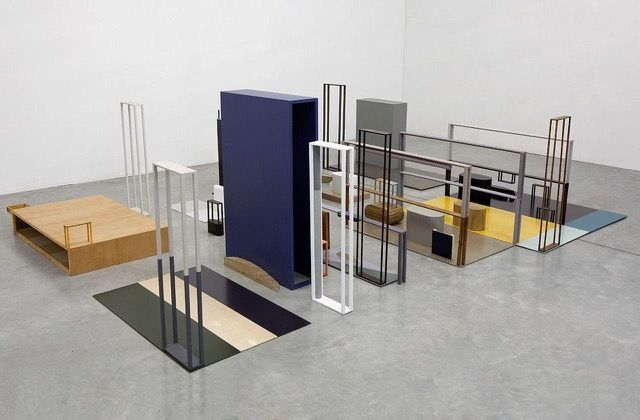
Looking back at the relatively young historiography of Israeli art – a scholarship that started to form independently only in the 1960s – a widely canonized status is awarded to the 1986 Tel Aviv Museum exhibition and catalog 'Want of Matter' (curated by Sara Breitberg Semel). Its title ('Poverty of Matter' literally), along with its participating artists, have become synonymous with a certain "quality in Israeli Art", in which ordinary, poor, ephemeral materials like cardboard, newspaper, plywood, and pencils represented the local preference of formal and material simplicity over the "conventional, polished aesthetics of the European Old Masters." This art historical argument and its curatorial realization also relate to international tendencies of that era, such as conceptualism and its pushes against the confinements of museums and towards alternative means of expression, like performance, video, and 'environments', often connected with more direct political statements.
Among the artists most associated with that loos, minimalist version of Israeli conceptualism of the 1970s and 1980s are Rafie Lavie, Tamar Getter, Nahum Tevet, Yehudit Levin, and Michal Na'aman, but also Efrat Natan, Michael Gitlin, Moshe Gershuni, Deganit Berest, and Joshua Neustein in wider contexts. In many of these earlier works one finds the playfulness of verbal and visual signs, next to a rather abstract performative act: words written large on the wall, planks of raw wood roughly painted, notebook pages torn and pasted, broken pieces of plywood strewn and painted over, or just placed over simple chairs at the corner of the gallery.
Reconsidering the place of sculpture within that cultural development, some interrelated factors may seem of special importance: for instance, the limited physical space and means, institutional or otherwise, for experimenting with large public installations in a country which 'grounds' are always contested territories of ownership rather than just 'open natural landscapes'. In addition, Israeli urban and suburban spaces, today more than ever before, host hundreds of memorials and monuments (some were made by leading artists who introduced abstraction to the local sculptural vocabularies, such as Yechiel Shemi or Menashe Kadishman). The evolution of local sculpture, with its forms, materials and themes, can hardly be understood free of that collective investment in commemoration. The generation of artists following that conceptualist-minimalist turn grew up within those historical and visual contexts. The complex conceptual basis for the delicate sculptures of Yael Efrati, Tchelet Ram, Ella Littwitz, or Moshe Roas may partly stem from the abovementioned tradition, but their (however highly different) meticulous praxis and innovative materiality move far beyond the alleged 'poverty of matter' of their teachers, while the expressive, immersive installations of Sigalit Landau or Gal Weinsteinmay be considered a significant link between the two generations. Whether materials are heavily manipulated or simply found, or whether the artistic act is a slight, smart gesture, or a full-fledged production of an imaginary environment, the various sculptural expressions along these local evolutions are almost always charged with the political meanings of the struggle for space, a place to make art and show it, but primarily a place to inhabit.